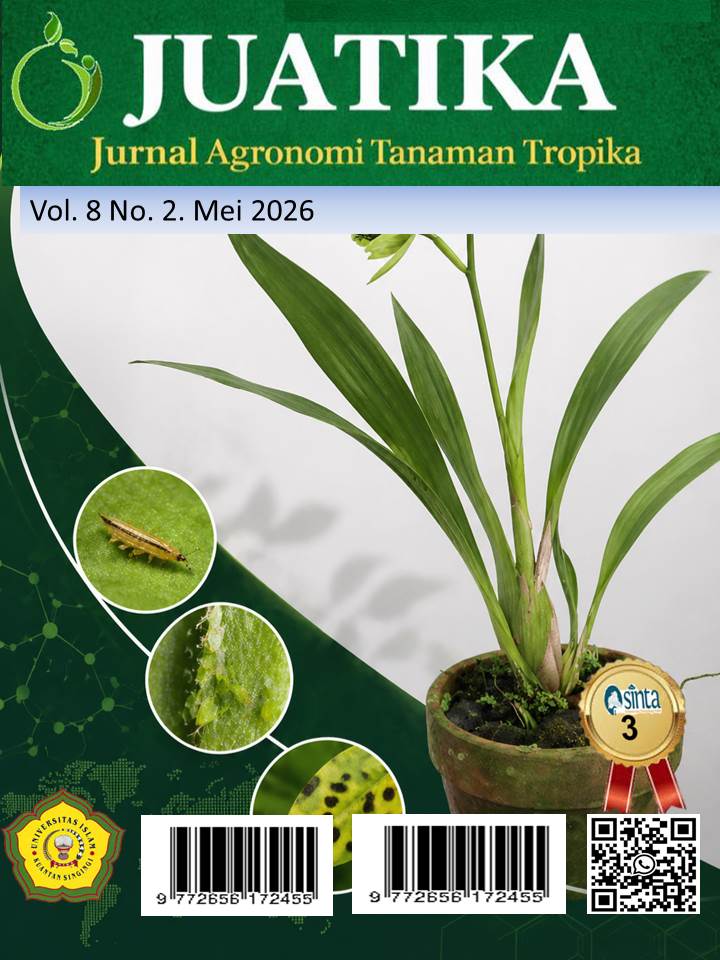
Effectiveness Test of Botanical Pesticide Formulation of Combination of Lime Leaves and Lemongrass Against Aphids (Aphis spp.) on Katokkon Chili Plants in-Vitro
Abstract
Aphids (Aphis spp.) are one of the main pests that damage Katokkon chilies by sucking plant sap and transmitting viruses. Excessive use of chemical pesticides can lead to resistance and environmental problems; therefore, environmentally friendly alternatives are needed. This study aims to determine the effectiveness of a botanical pesticide formulation derived from lime (Citrus spp.) leaves and citronella (Cymbopogon nardus) against Aphis spp. Mortality in vitro. This experiment used a completely randomized design with 7 treatment levels (R1-R5, KP, KN) and 5 replications. Observed parameters included physicochemical stability of the formulation (pH, density and viscosity), pest mortality from 4-72 hours and toxicity based on probit analysis (LT50). Results showed that formulations were stable in storage for 14 days, with the smallest changes in pH, density and viscosity. The highest mortality was found in R4 (83.33%), followed by R3 (70.83%) and R2 (62.50%), while solvent control reached only 2.50%. Probit analysis revealed that R4 gave the shortest LT50 value (8.70 hours), followed by R3 (24.93 hours) and R2 (35.61 hours). Based on these results, a combination of lime and citronella, with a ratio of 25%:75% (R4), is the most effective formulation as a botanical pesticide against Aphis spp.
Downloads
References
Ahmad, A. (2024). Pengaruh konsentrasi ekstrak daun jeruk terhadap mortalitas kutu daun pada tomat. Jurnal Agroindustri Lingkungan, 6(2), 54–61.
Daryanto, A., Nugroho, K., & Wibowo, H. (2020). Budidaya cabai dan pengendalian hama terpadu. IPB Press.
Driyunitha, R. (2025). Analisis usahatani cabai Katokkon di Toraja Utara. Jurnal Agribisnis Ekonomi Pertanian, 11(1), 55–62.
Farhan, R. (2021). Strategi pengendalian kutu daun dengan pendekatan agroekologis. Jurnal Perlindungan Tanaman, 14(2), 99–107.
Franco, D. (2019). Aphid infestation and its economic impact on horticultural crops. Journal of Economic Entomology, 112(6), 2827–2834.
Gamboa, V., Martinez, R., & Acosta, C. (2021). Morphological variation of aphids in tropical vegetables. Entomology Reports, 5(2), 112–118.
Ghosh, A. (2020). Biocontrol suppression due to synthetic pesticide use: Review and implications. Ecotoxicology Reviews, 3(1), 45–59.
Irawati, S. (2018). Pengujian stabilitas fisika–kimia formulasi emulsi. Jurnal Ilmu Teknologi Farmasi, 9(2), 134–140.
Jaya, A., Fenny, H., & Nining. (2024). Efektivitas ekstrak daun jeruk terhadap kutu daun pada tanaman cabai. Jurnal Agroteknologi Tropika, 12(1), 31–39.
Kaloli’, V. F. (2023). Intensitas serangan hama dan penyakit pada tanaman cabai Katokkon. Agroprima, 9(1), 23–30.
Kasmiati. (2021). Potensi ekonomi cabai Katokkon sebagai komoditas unggulan lokal. Jurnal Hortikultura Nusantara, 7(2), 78–85.
Ma’ruf, A., Siregar, E., & Lubis, R. (2024). Dampak musim terhadap intensitas serangan kutu daun pada cabai. Agroclimate Journal, 6(1), 11–17.
Mantzoukas, S., & Lagogiannis, I. (2019). The effects of aphids as virus vectors in vegetable crops. Plants, 8(10), 386.
Mariana, R., Suryani, & Wulandari, I. (2024). Komposisi senyawa kimia daun jeruk dan aktivitas biologisnya. Jurnal Fitofarmaka Indonesia, 10(3), 159–167.
Minanda, O., & Bambang, S. (2022). Perilaku semut terhadap cairan manis yang dihasilkan kutu daun. Bioeksakta, 4(3), 201–207.
Mougiou, N., Kalivas, D. P., & Tsiros, E. X. (2021). Advances in Capsicum cultivation and production economics. Agricultural Sciences, 12(4), 445–456.
Mumba, T., & Rante, B. (2020). Analisis kandungan minyak atsiri serai wangi lokal. Jurnal Kimia Tropis, 8(2), 89–95.
Najmah, N., Prasetyo, R., & Fauzi, M. (2023). Fitokimia serai wangi dan aktivitas insektisidanya. Jurnal Bioteknologi Hayati, 14(1), 66–73.
Nopriansyah, D. (2023). Mekanisme toksikologi sitronelal terhadap serangga hama. Jurnal Entomologi Terapan, 7(1), 101–110.
Puspasari, T. L. (2024). Dampak pestisida kimia terhadap organisme non-target. Jurnal Ekotoksikologi Tropika, 5(2), 120–130.
Sari, U. N., Mutmainah, & Masluki. (2024). Efektivitas kombinasi serai wangi dan bawang putih terhadap Aphis gossypii. Jurnal Perlindungan Hortikultura, 5(1), 72–80.
Siagian, D. (2023). Metode bioassay untuk evaluasi efektivitas pestisida nabati. Jurnal Biologi Tropis, 15(1), 45–53.
Syaifuddin, M. (2023). Evaluasi serangan Aphis spp. dan alternatif pengendaliannya. Jurnal Perlindungan Tanaman Indonesia, 27(2), 142–150.
Copyright (c) 2026 Driyunitha Driyunitha, Yulius Pakiding, Sion Oktafianus

This work is licensed under a Creative Commons Attribution 4.0 International License.
Authors who publish with Jurnal Agronomi Tanaman Tropika (JUATIKA) agree to the following terms:
Authors retain copyright and grant the Jurnal Agronomi Tanaman Tropika (JUATIKA) right of first publication with the work simultaneously licensed under a Creative Commons Attribution License (CC BY 4.0) that allows others to share (copy and redistribute the material in any medium or format) and adapt (remix, transform, and build upon the material for any purpose, even commercially) with an acknowledgment of the work's authorship and initial publication in Jurnal Agronomi Tanaman Tropika (JUATIKA).
Authors are able to enter into separate, additional contractual arrangements for the non-exclusive distribution of the journal's published version of the work (e.g., post it to an institutional repository or publish it in a book), with an acknowledgment of its initial publication in Jurnal Agronomi Tanaman Tropika (JUATIKA). Authors are permitted and encouraged to post their work online (e.g., in institutional repositories or on their website) prior to and during the submission process, as it can lead to productive exchanges, as well as earlier and greater citation of published work.





 More Information